














Scrolling on social media, it doesn’t take long to find videos of political candidates promoting their campaign, discussing their policies, or providing supporters and potential voters with important news. Social media campaigns have played an increasingly vital role in recent election cycles; former President Barack Obama, for example, was catapulted from being a little-known senator in Illinois to the presidency, thanks in part to his skillful use of social media to reach voters. In last year’s New York City mayoral election, candidate Zohran Mamdani used short, fun video clips to elevate his campaign and win the hearts of New Yorkers, which worked tremendously well. Current president Donald Trump, throughout his two terms as president, has also turned to social media to give updates to voters and provide institutional communication — yet his communication style has differed drastically compared to that of past presidents.
While it may seem unbelievable that the President would post that “A whole civilization will die tonight” or that those who don’t celebrate “each and every fantastic win I have” are losers, Trump continues to post to social media in this style. Throughout his second term, Trump has drawn criticism from many sources over his haphazard social media communication style, and even some of his own loyal supporters are starting to see the reality: there’s something wrong with the White House and Trump’s social media.
A History of Conduct
From the inception of the American presidency, presidents have long sought to uphold the highest standards of moral conduct and etiquette. George Washington was highly praised for his excellent moral character and deep understanding of how he should conduct himself as president. Since Washington set that standard, moral leadership has been a quality that voters and citizens have always looked for in their leaders. The inherent nature of the presidency requires that one consider words and actions carefully, as they are representative of and impact all of the nation.
The style in which a president communicates has always been the most revealing quality that points towards a president’s conduct. Washington, in his first State of the Union address to an American nation newly freed from despotism, knew just how important it was that his communication be respectful to preserve the brand-new tradition of the American presidency. In these early forms of communication, presidents were careful when calibrating their messages — after all, they recognized the significance of a positive public opinion as an indicator of their success. Abraham Lincoln’s presidency brought about the telegraph, which was vital in promoting Lincoln’s speeches to the public and facilitating debates. Franklin D. Roosevelt famously delivered his fireside chats to a struggling, hopeless nation facing the greatest economic crisis of the industrialized world, offering American citizens a comforting, conversational explanation of New Deal policies and economic progress.
What all of these presidents have understood is that public opinion generally favors presidents who firmly value respectful, strong communication. Rather than directing their speech towards tearing down opponents, they have used speech to uplift the work they have done as presidents. Even as social media has created yet another medium of presidential communication, presidents before Trump have continued to direct their social media use in line with the values of their predecessors. Dr. Daniel Kreiss, a professor of political communication at UNC-Chapel Hill whose research focuses on how elected officials use social media to communicate, notes that nonpartisanship on official accounts has generally been the norm.
“The official accounts that are tied to that office will be nonpartisan in the sense that the person who holds that office as an elected official is supposed to be the governor of all the citizens, regardless of their political party,” Kreiss says. “So it has historically tended to be a much more formal and less partisan, less direct use of social media for exactly that reason.”
No More Norm
With this standard in mind, it doesn’t take longer than a few minutes to discover that, on any form of social media, the official White House pages under Trump’s presidency (or Trump’s personal accounts) stray incredibly far from what presidential communication has historically been. The White House or Trump’s accounts on social media platforms such as TikTok, Instagram, X, and Truth Social (a form of social media Trump created after being banned by the aforementioned platforms to bypass mainstream media and its inherent “liberal bias”) post incredibly frequently and with what appears to be less moderation than ever before. While Trump has been historically active on X since its creation, his reach on social media platforms in general has only expanded in his second term.
Kreiss notes that where Trump has really broken the norm is that there is no longer much distinction between Trump’s personal accounts and official accounts, like the White House, or even state agencies.
“[The accounts] have been much more willing to engage in partisan forms of politics as an extension of the president’s political operation in his political party,” Kreiss says. “There is no separation between what is an official role and what is a partisan position or a partisan political figure who has a coalition; all these things are blended in during the second Trump administration.”
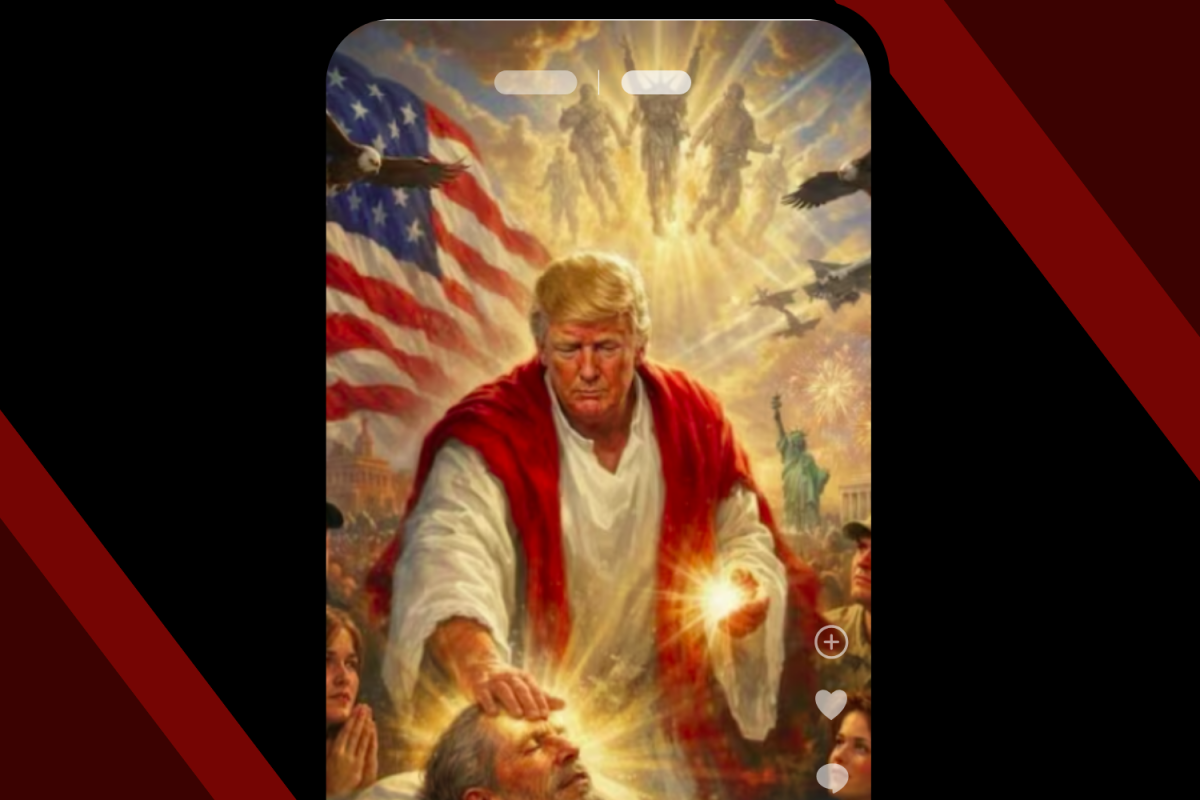
While most political figures today use their official social media accounts to give constituents updates on policies, the posts that Trump or official accounts create don’t have this same purpose. Trump’s posts are undoubtedly self-aggrandizing and aimed at making political enemies seem weak or disgusting in some sort of way, as seen by his Truth Social post of a doctored image of Candace Owens on the front page of a Time magazine after Owens dared criticize the president’s conduct in Iran, or the post Trump made (and later took down) of him as a “doctor” that uncannily portrayed him as a Jesus-like figure and drew widespread criticism from Republicans. The AI-generated images that Trump and the official White House accounts post are incredibly unprofessional when viewed as official communications from the highest office of one of the world’s most powerful countries.
How Did Trump Get Here?
Trump’s peculiar social media posts may not seem as perplexing to a viewer in 2026 as they might have twenty years ago, when institutional communication and getting news via social media had just begun to grow. Social media has changed how the public is involved in political life, especially for teenagers and young adults — a study from the Pew Research Center found that 53% of US adults ages 18-24 get news from social media “often” or “sometimes” as of 2025.
“Fewer and fewer people, especially younger people, turn to professional news outlets and more professionally filtered forms of news, and now increasingly see things that are delivered to them via algorithm on TikTok, that come from the social media accounts of their supporters, things that their friends or family share on Instagram, or that come through influencers of various varieties…” Kreiss says. “It is the primary source of information that people have about political life, and it’s absolutely central to how people understand political processes, and then the people who are either in office or trying to gain office.”
As more and more people turn to social media for news and information about political processes and figures, it also shapes how they perceive communication standards. Slowly but surely, the inherently “authentic” and instant nature of social media has changed how political figures communicate.
“In the past, you had to sit down, write a press release, and send it out to journalists. Journalists have to be the filter to the mass audience, whatever that might be,” Kreiss says. “[Posting on social media] gets rewarded in various ways, and that’s another reason why there’s an incentive for it. People appreciate the genre of social media, the directness of it, and the perceived authenticity of it, and therefore, politicians notice what gets them likes and what gets them engagement on social media platforms. They’re deeply attentive to that… because they know that’s what’s getting an audience reaction.”
While Trump is certainly a good example of a figure whose communication style is deeply connected with the casualness and directness of social media, Trump’s model is starting to be adopted by other prominent political figures across political parties.
“Political figures like Ron DeSantis, etc., are willing to push those boundaries of what’s an official role versus what’s a partisan political figure,” Kreiss says. “On the Democratic side, I certainly think someone like Gavin Newsom is a great example of somebody who is following Trump’s lead in terms of a directness and maybe trying to cultivate a perceived authenticity of his speech in ways where he’s just willing to say and do things that, again, the consensus in both parties 20 years ago might say that’s beneath the dignity of the governor of California.”
The “authenticity” of speech that social media allows politicians to use as a tool doesn’t have to come with mockery, however. Politicians can use social media’s directness to their advantage by lifting others up and carefully elevating their platforms rather than mocking those who disagree. Authenticity is certainly appealing in an elected official, as most voters don’t understand the same “legal” language that politicians sometimes speak. But those on the receiving end of mockery or disinformation bear the deeply upsetting knowledge that their President is willing to ridicule them or their beliefs in an online space for millions to see.
The President Who Cried Wolf
When the president continues to treat social media in an unprofessional and unserious manner, it risks diluting the importance or awareness of valuable information. It’s easy to grow accustomed to the president’s lack of online decorum and dismiss each post because of perceived unseriousness. But how can the public interpret and evaluate posts from Trump and official government accounts, or any political figure, when drowning in an endless sea of AI images and haphazardly capitalized words?
“The first lens that I would put [social media posts] in would be, is this elected official serving in a role in public life where they transcend partisanship when it comes to governance?” Kreiss offers as a guiding question. “I think that should be the standard for elected officials on both sides of the aisle, meaning that you know there’s a responsibility of office that once you get elected, you govern in a way that’s guided not by partisan concerns, but what’s in the best interest of the country, and that includes all Americans.”
While some elected positions may have a greater allowance for partisanship in communication, the office of the President doesn’t have this same flexibility. The President represents an entire, incredibly diverse country — not just a single town, district, or party. Communicating to all of America transcends the rigidity of partisan speech and ideas. While this doesn’t mean that an elected official’s agenda or policies must be nonpartisan, communication should at least signal respect for all people. Institutional communication, especially from the President, requires tremendous responsibility and care to uphold every person’s dignity rather than to ridicule, humiliate, manipulate, or deceive.
This standard applies to both official government pages, such as the White House, and the president’s own social media accounts. While Trump’s posts on his personal social media accounts don’t quite carry the same connotation that those of official government pages do, his posts are nonetheless interpreted by the public in much the same way that posts from official agencies are. Both require that the president and his administration uphold the highest standards of moral character, etiquette, and respect.
America is in desperate need of a president who can respect the dignity of the human person and uphold the highest standard of professionalism in online spaces. Kreiss, the father of an 8-year-old son, says that officials should be held to the same standards of morality that would be expected of children.
“We have to raise our kids to be ethical towards others, and that’s what I expect of my son, and that’s what I know his second-grade teachers expect of him,” Kreiss says. “We should have the same expectations of the people who are in public life.”
When videos of Immigration and Customs Enforcement agents arresting people through violent means and showing their most vulnerable moments are posted to a popular audio on TikTok by the White House, democracy suffers. When Trump posts a video of himself depicted as a king flying in a fighter jet, an idea far from the ideas of liberty and restricted executive power that America was founded on, democracy suffers. When Trump posts an errant and offensive rant about the Pope, the highest religious leader of one of the largest world religions (and that makes up approximately 20% of America’s population), democracy suffers. What Trump’s behavior online, from his first term to now, has shown is undeniably this: America’s president is called to higher standards.