


































Naomi Medrano-Delgado’s mom used to tell her and her siblings that there were bigger and better things in the U.S. That they should be “grateful” for the opportunity to leave the country they grew up in. But this isn’t how she and her siblings saw it; they wanted to stay in their home country. After all, who wants to leave their friends, relatives, and culture for another country?
“Moving to a new school may not be so scary, but having to move to a new country, learning a new language, making new friends, and having a new timezone is terrifying,” Medrano-Delgado said.
This scenario is a reality for many of Davie High’s English as a Second Language (ESL) students. While not all of these students have recently moved to the US, many come from countries where English is not the primary language. At Davie, the ESL program is predominantly made up of Hispanic students.
Learning a new language can be very challenging, but that is not the only struggle that ESL students face. For many immigrant families, coming to the U.S. is a dream. For most, it is the American Dream—the belief that anyone can succeed through hard work and determination upon arriving in the U.S., regardless of their background. Children are taught to be grateful for the chance to move to a new, better country. For students like senior Col Lopez Salgado, though, that dream begins with leaving everything familiar behind.
“As ESL students, the first challenge we face is leaving our home country,” Lopez Salgado says. “Leaving the place where we grew up and all our loved ones is one of the hardest things. We all leave for different reasons, but most of the time it’s for a better life and future.”
Coming to a new country can bring feelings of excitement, a fresh start, and an opportunity to meet new people, though adjusting to a new language and culture presents numerous challenges. Adapting to a country’s writing styles, pronunciations, and accents is just one of the many obstacles these students must overcome.
Another issue can be a lack of confidence and motivation. While learning a new language, students may feel stressed or upset knowing that they can’t understand class jokes, group activities, and assignments.
“Now we have technology and tools that help us understand people, but the scariest part is speaking,” Lopez Salgado said. “Some people think it’s easy to just talk, but it’s really scary because we feel like we will say something wrong or everyone will laugh at us.”
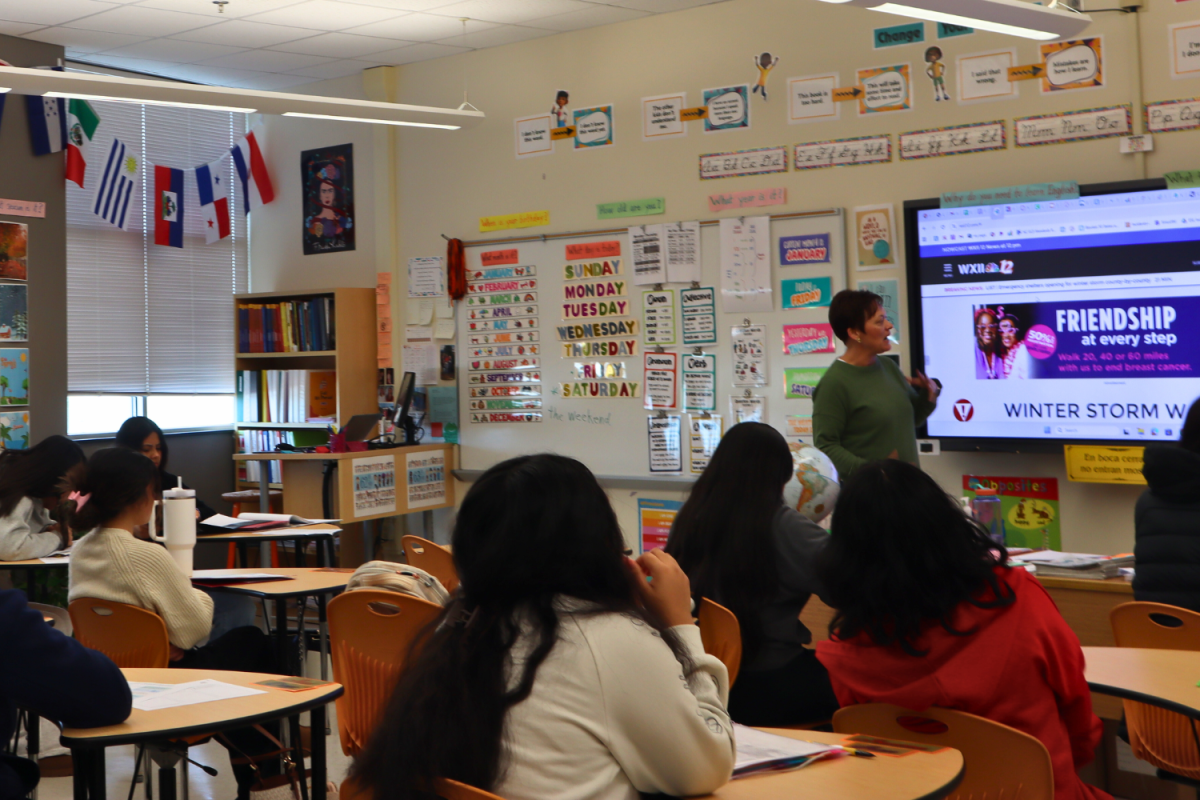
Outside of ESL class, students may struggle to understand certain concepts, especially when no one is available to offer support. Teachers try their best to help students who struggle with English, but sometimes it can be challenging to explain concepts due to the language barrier, a reality that ESL teacher Susan Marion works to combat daily.
“In ESL class, everybody is sort of on the same level in learning English,” Marion said. “Some may know more than others, but everybody shares the same struggle. In their other classes, where they’re with other English-speaking peers, I think they do have a lot of difficulties because it’s very challenging for them.”
A Sense of Belonging
In ESL class, everyone is at the same pace, and whether some may learn more English than others, everyone understands each other. There are a variety of countries that come together for the same reason: learning English. ESL students may feel connected to one another and become each other’s support system; they may also form close friendships, sharing their diverse cultures, religions, and languages in a small classroom. Having class with another ESL student makes them feel less alone.
Marion’s goal is to help students feel a sense of belonging. She helps students overcome their struggles and prepares them to succeed in English. Marion may add students to classes where they have other peers who speak the same language to make them feel a bit more comfortable in classes outside of ESL.
“We are a family in ESL class,” Marion said. “It’s a community that we have. I want the students to know that I love them and respect them, that I’m here for them, to nurture them as well as to teach them. And when students feel secure and feel accepted, they’re more capable of learning English.”
Even though many challenges come with learning a new language, with the help of Marion and their peers, ESL students become more comfortable speaking English. While other students may view having to learn English as a weakness, students in ESL classes are proud of the chance they have to continue learning together as they keep their roots alive.
“There are many challenges migrant students face, and sometimes they affect us in different ways, but what matters is to understand and remember that everyone is different,” Salgado said. “Being an ESL student is not always easy, but it makes us stronger. We are proud of where we came from, proud of our roots, and even though we miss our countries, we know we came here to build a better future, and that makes it worth it.”