





























Winter break left many students drowsy and unenergized; however, that doesn’t stop the fact that fall semester exams are just around the corner. This coming exam week is an anomaly among the previous years for exams, as, instead of two weeks for final exam review, there’s just one. One week for a student to do all of the cramming and procrastination they could possibly need.
Last year, snow and weather-related troubles changed the typical exam schedule. This year, exams will be returning to their normal schedule, and teacher-made exams will be held all in one day.
When do I have to be here?
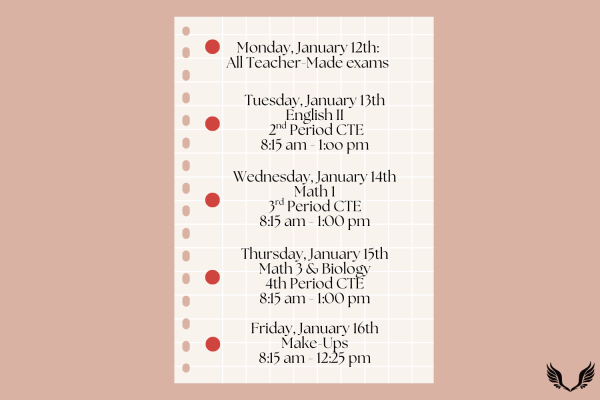
As predicted, exam schedules raise questions without fail every year. “When do I need to be here?” “Do I have a state exam?” This article will answer all of your questions about this coming exam week.
If you have a state exam, it is required that you show up and take it on the specified day. If you have a reason for missing the exam (e.g. a doctor’s note), that will need to be provided to allow you to make up the exam. Communication with your teacher is key. Make sure they know if you can’t make it.
As far as teacher-made exams go, you are exempt from your exams if you have an 80 or above in the class for the semester and have 8 absences or fewer (not including the day of exams.) These are the following classes that mandate an exam (no exemptions for any reason).
End-of-Course Exams
- Math 1
- Math 3
- English 2
- Biology
CTE Exams
- Interior Design Fundamentals
- Food and Nutrition I
- Food and Nutrition II
- Culinary Arts and Hospitality
- Agricultural Mechanics II
- Biomedical Technology
- Health Science I
- Child Development
- Business Management
- Business Essentials
For all exams, students must arrive and be at their designated testing location before 8:15 AM when the exam will start exactly at that time. Once your exam is complete around 1:00, an announcement will be made for students to go home.
If I’m Exempt, What Happens If I Take the Exam Anyway?
If you qualify to be exempt from the exam but decide to take it anyway, the exam cannot hurt your semester average. In other words, if you wind up in class for this exam but you don’t have to take it, that doesn’t mean you shouldn’t. A student with an 89, for example, might want to take the exam to see if their grade will bump up to an A. With exams weighing 20% of the semester average, this is a real possibility.
What If I Have a Yearlong Class? AP Classes?
All teachers must have an exam ready for students to take. If you are in a yearlong class, it will have a teacher-made exam. The same applies to AP classes that are held for 2 semesters. In addition to the AP exam itself, these classes also have teacher-made exams. If you meet the exemption requirements, you do not have to take these exams, though you may choose to do so for practice or for a chance to improve your semester average. AP exams do not count towards your grade for the class but do create an excellent opportunity to present to colleges and focus on college-level course work. The AP exams will take place in May, giving you plenty of time to prepare.
When Will I Have My Grades?
When it comes to teacher-made exams, it’s imperative to be patient as all exams look different. It can be a multiple-choice 55-question AP-style test or even writing a timed essay. While there is no prediction as to when you will get your teacher-made scores, you can know what to expect with state-mandated exams. Typically with state-mandated CTE exams, you will be able to access your scores by the end of the testing session. Whereas core exams will take longer to be processed and considered.
If you are taking the English II EOC in particular, be prepared to wait for up to a week for your results. Of all the End-of-Course exams, this is the only one that includes written response questions that have to be graded by individual readers at the state level. This is one reason why the English II EOC is given on the first day of exam week: there is more time for the grades to be returned to the teachers before report cards go out.
Anything Else?
Exam season can be tough, but there are still things you can do to make it manageable. Most people have heard that you should eat before your test, that way your brain is at its full potential to take an exam. But bringing a lunch and snacks for afterward is also imperative to getting through the “hurry up and wait” portion of the testing session. Once everyone in your testing room has finished, there is often a long period of sitting. You won’t be able to access your phone until the testing session has concluded. It is highly suggested that you bring a book, something to sketch with, a coloring book, or something non-electronic to entertain yourself.
There is little you can do to avoid the stress and anxiety that comes with the bland and sterile white-and-black testing format, but you can avoid being unprepared. If you are someone who finds yourself frequently chewing gum in class, chew the same flavor of gum to jog your memory. There are many methods of studying that can be found on Pinterest, and you can try a couple until you feel something sticks in your brain.
If you have never tested before, once it’s over, it’s over! There is nothing you can do to change your work, and while that concept is scary, it’s also somewhat freeing. You are done with the stress and the buildup, and you are free to make new decisions and even do better in the future. Think as positively as is feasible for you, and when it’s done, it’s done.