
Skip to Content
Categories:

An All-American Tradition: Immigration and Deportation

The pattern of immigration and deportation is nothing new in the United States. Immigrants have often been the subject of scrutiny, and those coming from certain countries or part of specific ethnic groups have often been targeted.
Natalie Quance

One of the hallmarks of the American identity is its diversity—a trait forged through the integration of millions of immigrants since the nation’s founding. And yet, there’s an intrinsic irony to it all.

The United States is renowned for the American Dream—a promise of a better future regardless of your ethnicity or socioeconomic status—but this paragon of “opportunity” has continuously rejected those who pursued it. 

This year, news coverage across the ideological spectrum has been filled with chilling tales of executive overreach. ICE has raided warehouses of businesses across the country. Children have been separated from their families and even placed in custody. Even American citizens have been wrongly detained by the Trump administration and denied due process. These recent mass deportations are just one of the many perils plaguing the ideals of the American Dream. 

In light of these events, immigration has—perhaps more than ever—become a major point of contention nationwide, sparking debates and even resistance. But unbeknownst to many, immigration and deportation have been contested historical recurrences in the US since its founding—a perfect exemplification of the mantra history repeats itself. However, this chapter of history has long been forgotten, buried deep under the rubble of the American Dream.

Early Beginnings, Spring of 1798

The controversy of immigration would begin in colonial America—a society that embodied the rich cultures of Europe, and the genesis of new diasporas. Dispersed from New England to the Carolinas were settlers from Germany, England, and beyond, but beneath this imagery of a haven for the persecuted, a spark of animosity lingered amongst this diverse population, waiting for a spark to ignite its hatred.

As the bitter winds of winter dwindled, the vibrant reverdie of spring swept across the West, but an onslaught of war followed suit. Conflict and revolution raged throughout Europe, and consequently, tens of thousands fled to the US seeking refuge. However, these immigrants weren’t welcomed; instead, they would come to be perceived as threats.

In 1798, the US stood at the brink of war with France, and as tensions heightened, the Federalist-controlled government feared for the safety of the newly emerged US. Criticism from their rivals, the Democratic-Republicans, and the onslaught of immigrants arriving in the US, were perceived as threats to national security. The party feared indoctrination, and to exacerbate their fears, the Democratic-Republican Party found avid support from the new immigrants, particularly the French.

Merely 22 years after the founding of the US, the first acts concerning deportation and immigration were passed: the Alien and Sedition Acts of 1798. This series of four acts bestowed upon the President the power to deport foreigners deemed “dangerous”, and the Sedition Act criminalized the publication of “false, scandalous, and malicious” statements defaming the government. In the event of a “declared war…or any invasion or predatory incursion…,” the government could deport, arrest, or detain so-called “enemy aliens.”

Vehement opposition arose from the Democratic-Republicans, who viewed these acts as a blatant abuse of federal power weaponized against civil liberties. In response, Thomas Jefferson and James Madison published the Kentucky and Virginia Resolutions, which declared the acts unconstitutional and further asserted the principles of state sovereignty. Further repercussions emerged as the Federalists faced growing backlash from the general public, consequently leading to a Democratic-Republican victory in the election of 1800. The Alien and Sedition Acts of 1798 would be repealed or simply forgotten. 

As these acts dwindled into irrelevance, the scornful gaze of American society would direct itself west, towards the many developing Chinatowns. 

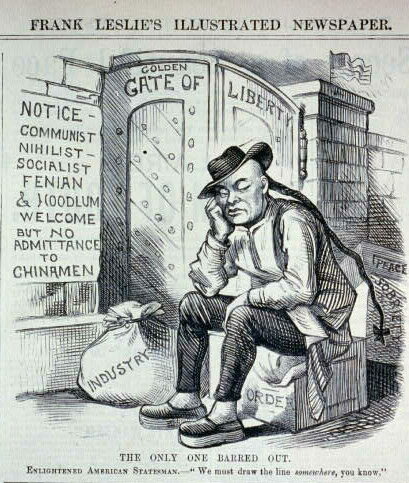
A political cartoon published in 1882 details attitudes towards Chinese immigration in California. | Image by Frank Leslie via Library of Congress Prints and Photographs Division. http://hdl.loc.gov/loc.pnp/ds.11861. (Public Domain)
Chinese 1800s

Welcome to 1870s Truckee, California, a chaotic railroad town filled with the click-clack of trains and the thundering boom of falling timber. For a more subtle excursion, take a trip to its vibrant Chinatown, bustling with shops and attractions! Truckee was one of the many emerging Californian towns with a large Chinese population, with over one-third of its residents being Chinese. But by 1886, only one building stood amongst a sea of ashes as the last remnants of a once lively Chinatown.

The fate of Truckee’s Chinatown is far from unique; the same demise would befall several Chinese settlements across the West Coast. But what led to this? 

The influx of Chinese immigration began with the California Gold Rush of 1849, and the population would only grow in the following years. Many were contracted laborers engaged in mining, agriculture, and railroad work. These workers, who could be paid a significantly smaller amount than white workers, were often favored by companies; consequently, this led to a widespread sentiment that Chinese laborers were “stealing” jobs. These economic tensions, along with the cultural divide and racial prejudice, culminated in the Chinese Exclusion Act of 1882.

With the implementation of the Chinese Exclusion Act, a 10-year total suspension was placed on Chinese laborers entering the US—the first instance of federal law prohibiting entry to an ethnic group on the grounds that it endangered good order. For any Chinese person traveling in or out of the country, a certificate was required for occupation identification. Restrictions tightened as Congress passed the Scott Act, making re-entry into the US nearly impossible due to a series of required certifications. In addition to immigration restrictions, Congress refused state and federal courts the right to grant citizenship to Chinese resident “aliens.” However, they retained the power to deport. 

When the Exclusion Act expired, Congress passed the Geary Act, extending it by ten years. The new Geary Act added further restrictions on immigration by requiring each Chinese resident to register and obtain a certificate of residency, with failure to do so resulting in deportation. This act would continue into the 20th century until it was repealed in 1943. 

Subsequently, the passing of the act would incite a flaming wave of violence against Chinese immigrants, provoking new exclusionary policies. When the initial passing of the act failed to mitigate the flow of immigration, vigilantes sparked mass anti-Chinese movements, primarily on the West Coast. These sentiments of hate and violence were spearheaded by organizations such as the Knights of Labor; in the town of Truckee, Chinese residents faced the fervor of the Caucasian League. 

The terror began with threats and minor assaults, but as economic hardship struck the town, the resentment surged. They boycotted, refusing to buy Chinese goods, and fired all Chinese workers; then, they took up arms and arson. Flames whipped through businesses, and water towers were blown into pieces. Chinese immigrants of Truckee would leave, succumbing to the violence, and so would those in Seattle, Rocky Springs, and so many more.
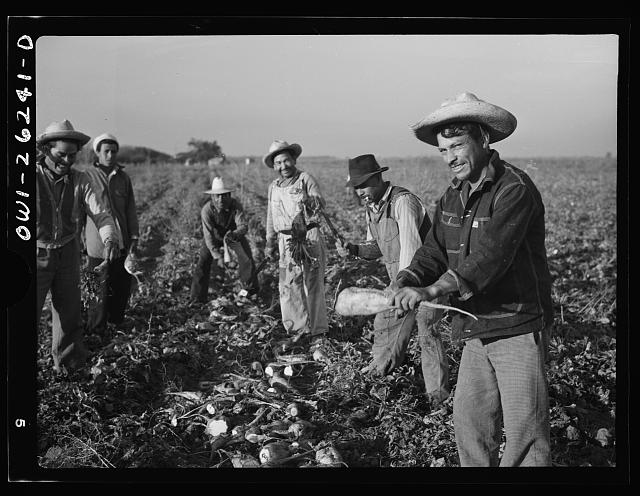
A political cartoon published in 1882 details attitudes towards Chinese immigration in California. | Image by Frank Leslie via Library of Congress Prints and Photographs Division. http://hdl.loc.gov/loc.pnp/ds.11861. (Public Domain)
20th Century Developments

With the dawn of the 20th century, an era of unease, along with political, social, and economic tensions, would provide the perfect environment for the development of further restrictive immigration strategies. 

As WWI raged on, a sense of apprehension regarding national security grew—the perfect political climate to pass the Immigration Act of 1917 (Johnson-Reed Act). This act established 2 new limitations: literacy tests and the “Asiatic Barred Zone.” Essentially, the act enforced a complete ban on immigration from Asian countries, excluding the Philippines and Japan, and mandated basic reading comprehension in any language for immigrants 16 or older. 

Seven years later, the Immigration Act of 1924 expanded upon the provisions of the previous act, whilst adding a new element: a quota system. The nature of this quota system heavily favored northern and western Europeans in comparison to other nationalities. Additionally, the 1924 Act would include Japan in the Asiatic Barred Zone. Ultimately, these acts aimed to promote homogeneity in the nation. 

Prior to the early 20th century, the primary focus of immigration control had been centered on the influx of Asian immigrants; however, a new group would begin to bear the burden: Mexican immigrants. To restrict the flow of immigration via the US-Mexico border,  Congress passed the Undesirable Aliens Act, transforming illegal immigration into a federal crime.

As the government scrambled to restrict the flow of immigration into the country, another issue arose concerning deportation. The process of formal deportation was slow, expensive, and often chaotic—the solution? Voluntary departure. When a non-citizen was detained or arrested, rather than undergoing the arduous legal processes, they were offered the option to deport themselves voluntarily. This system was efficient, cheap, and left no records behind. 

All of these factors, combined with the formation of the Border Patrol, instituted the first attempt at mass deportation by the US. 

Great Depression

The melodic hum of music dances through the air as you navigate your way through La Placita, LA. You immerse yourself in the festivities, wandering through the heart of Mexican Los Angeles; this vibrant cultural hub leaves no room for boredom. Once you’ve finished, you make your way to the exit, but before you’re able to take another step, you are suddenly surrounded by several men in olive uniforms wielding guns and batons—Border Patrol

Everyone—all 400 people—is instructed to line up and present their papers. In the end, dozens were arrested and several deported. The La Placita Raid would be one of the many that occurred during the Great Depression. 

In times of crisis, it’s natural to seek a scapegoat; in the 1930s, the sacrificial lambs were the Mexican immigrants. As unemployment and food shortages swept across the country, blame was increasingly placed on Mexican immigrants on the premise of robbing “real” Americans of resources and employment. As bitterness escalated to action, a series of raids flooded the country.

While it’s estimated that 44,000 people were prosecuted under Section 1325, a majority of the raids were informal, lacking due process. These informal raids weaponized coercive methods to induce hundreds of thousands of immigrants to voluntarily deport themselves. In total, it’s estimated that 2 million people of Mexican heritage were forcibly removed, with 1.2 million having been born in the US; many were unable to ever return to their birthplace. California alone deported about 400,000 American citizens and legal residents without their promised rights to due process and equal protection of the law.  

Stockton (vicinity), California. Mexican agricultural laborer topping sugar beets | Photo by Marjory Collins via the Library of Congress https://lccn.loc.gov/2017853212
The Braceros Program

Entering World War II, the US faced another pressing issue: a labor shortage. As men joined the war in drones, the threat of an economic crisis loomed at hand; so, the US sought a solution southward, towards Mexico. 

Only a few years prior, the US had condemned Mexican immigrants as threats; yet in times of need, they sought the ones they so desperately wanted gone. The Braceros Program was established by both the US and Mexican governments as a guest worker program allowing the temporary importation of Mexican laborers. For the US, this program served the purpose of preventing a disruption of agricultural production. To entice laborers, Congress promised protection from exploitation and discrimination—it worked. Hundreds of thousands of men flocked to apply for a chance to earn a better wage. 

In 1948, the contracting system was adjusted to create a more flexible labor force, and government negotiations were exchanged for contracts between growers and individual laborers. However, the limited number of contracts and an immense demand for cheap labor led to a substantial population of unauthorized Mexican laborers in the US. A popular route many migrants took to enter the US was through the Rio Grande River, stigmatizing them with the name and stereotype, “wetbacks.” This derogatory title fueled the anti-Mexican sentiment within the US, painting them as criminal invaders. 

Despite the promises of safety and inclusion, Mexican laborers were racialized as an “alien race,” with several states enforcing segregation policies against them. Within their daily work, laborers, particularly undocumented ones, were increasingly exploited by their employers; many were given wages far below the legal minimum and denied the rights to basic needs. But employers weren’t concerned over retaliation; to them, these laborers were expendable. Their status branded them as illegal aliens—criminals to society—vulnerable and easily deportable. 

The influx of undocumented laborers continued to grow exponentially, generating significant outcry from the American public. In fact, anti-immigration sentiments towards Bracero laborers began as early as 1943, claiming that they undermined employment opportunities for white Americans. Mounting public outrage, paired with the support of the Mexican government, which felt as though the increasing volume of migrants exposed their failure, led the government to nearly double the number of Border Patrol officers. These operations would describe themselves as “drying out” the “wetbacks;” one of the most infamous campaigns would be dubbed Operation Wetback.
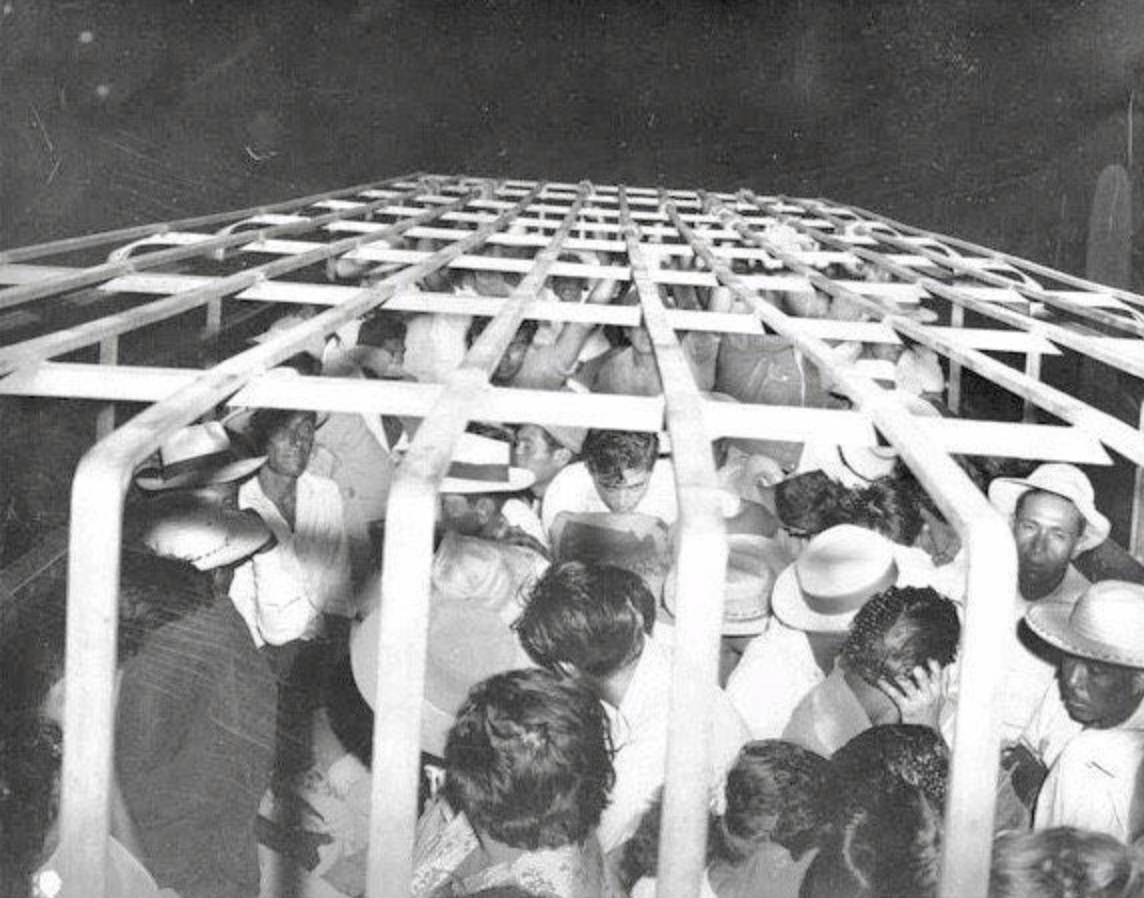
Stockton (vicinity), California. Mexican agricultural laborer topping sugar beets | Photo by Marjory Collins via the Library of Congress https://lccn.loc.gov/2017853212
As part of Operation Wetback, Mexican immigrants were packed into trucks during their transportation. | Image by U.S. Border Patrol Museum (Public Domain)
Operation Wetback

1950s United States: a time of pervasive paranoia—the height of the Red Scare and McCarthyism. Neighbors glared at each other with suspicion and animosity, but their fears were increasingly directed at a different group of people: immigrants, specifically, Latino immigrants. 

Now, in addition to claims of occupational theft, Latino immigrations were perceived as a political threat. As anti-communist sentiments heightened, so did the alarm for national security from immigrant infiltration. Amidst the spiraling fears, efforts to distinguish between undocumented immigrants and citizens of Mexican descent were lost. 

These fears would eventually make their way into the floors of Congress, culminating in the McCarran-Walter Act of 1952. At a glance, the revisions of the act seemingly favored immigrants; however, later provisions did not. The complete exclusion placed upon Asian immigrants established by the 1929 act was repealed, and a suspension was placed on the deportation of individuals who have resided in the US, with American spouses, for 7 consecutive years. Additionally, this act allowed the trial for illegal reentry to be held in any district in which the individual was found. The penalty for a first illegal entry was also reduced to a petty offense, but after the defendant was charged, they would lose the right to a jury trial. 

The S.S. Emancipacion swayed gently in the Atlantic waves, bow bound south. Its hull is filled with an abundance of cargo—dozens of deportees crammed together. Its conditions would later be described by a congressional investigation as resembling an “18th-century slave ship.” On land, 88 bracero laborers died of heat stroke, while hundreds of thousands wandered aimlessly in the town of Mexicali. These tales are far from unique; they are just one of the many incidents in Operation Wetback.

In 1954, Attorney General Herbert Brownell released an announcement: in the following months, the US Border Patrol would launch a surge of 800 officers across the Southwest, enforcing a series of raids and mass deportations. The campaign began on June 10, 1954, as the Border Patrol established several checkpoints within California and Arizona. Nearly 11,000 would be apprehended in the next 7 days, and by June 30, it would double. Not only that, agents often threatened employers who had undocumented laborers with constant raids if they did not use the Bracero Program. Border Patrol continued to raid Mexican communities across California, Arizona, Texas, Chicago, Illinois, and the Mississippi Delta, and by the end of that year, a reported 1 million deportees were apprehended. 

While it seemed as though the operation had only one goal: deporting as many Mexican immigrants as they could, there was an ulterior motive. Border Patrol aimed to display a spectacular show of force to the public with the hopes of instilling fear within remaining Mexican immigrants—it worked. In Texas alone, over 63,000 would voluntarily return to Mexico. 

The operation concluded by the end of the year, and it was deemed a success. For a short time, it did succeed in deterring illegal immigration. However, with the end of the Bracero Program in 1964 and a growing need for laborers in agricultural industries, the number of undocumented entries would rise again in the following years. Not only that, it’s suspected that the true number of apprehensions was far lower than 1 million, perhaps as low as only 300,000 detainees. 

As part of Operation Wetback, Mexican immigrants were packed into trucks during their transportation. | Image by U.S. Border Patrol Museum (Public Domain)
Legislation from 1965 Onward

In 1965, Congress would pass the Hart-Celler Act (also known as the Immigration and Nationality Act of 1965), easing several longstanding restrictions on immigration. The quota system was lifted, replaced with a new method that prioritized skilled immigrants and familial relations. Through the family reunification clause, immigration for those with family already in the US was made far easier. 

From the 80s to modern times, additional acts have been passed to shape the immigration process. These include the Immigration Reform and Control Act, the Immigration Act, the Illegal Immigration Reform and Immigrant Responsibility Act of 1996, the Secure Fence Act, the Trafficking Victims Protection Act, and the Deferred Action for Childhood Arrivals executive action.

Conclusion

You’ve now read it all—the history, and more importantly, the cruelty. You’ve seen how time and time again, our society has only viewed immigrants as a tool, discarding them when we see fit. Immigration is an issue that ebbs and flows as our economy, politics, and culture shift throughout the decades. It’s an issue that should be approached with nuance, and most importantly, humanity, but we’ve failed to recognize this—even now. 

During this time of economic instability and political unrest, we’ve once again condemned America’s favorite scapegoat: immigrants. Examine Trump’s recent executive orders and actions regarding deportation. Isn’t there a strange sense of deja vu? His mass raids, fear-mongering, and his many wrongful deportations—mistakes at the expense of several American citizens—are all reminiscent of the past.

The history of immigration gives us the greatest insight into the paradoxical nature of the American Dream. These immigrants—illegal or legal—followed the promise that merit and diligence would lead them to a better life. Still, time and time again, just the mere status of being an immigrant is a crippling force in their pursuit of upward mobility. We, the people, have rejected their pursuit of happiness, branding them as thieves and an “alien” race—truly ironic.

Donate to The Weekly Talon
$135
$500
Contributed
Our Goal

Your donation will support the student journalists of Davie High School. Your contribution will allow us to purchase equipment and cover our annual website hosting costs.

More to Discover
Donate to The Weekly Talon
$135
$500
Contributed
Our Goal